.png)
Build a Minimal Effective Skincare Routine That Works

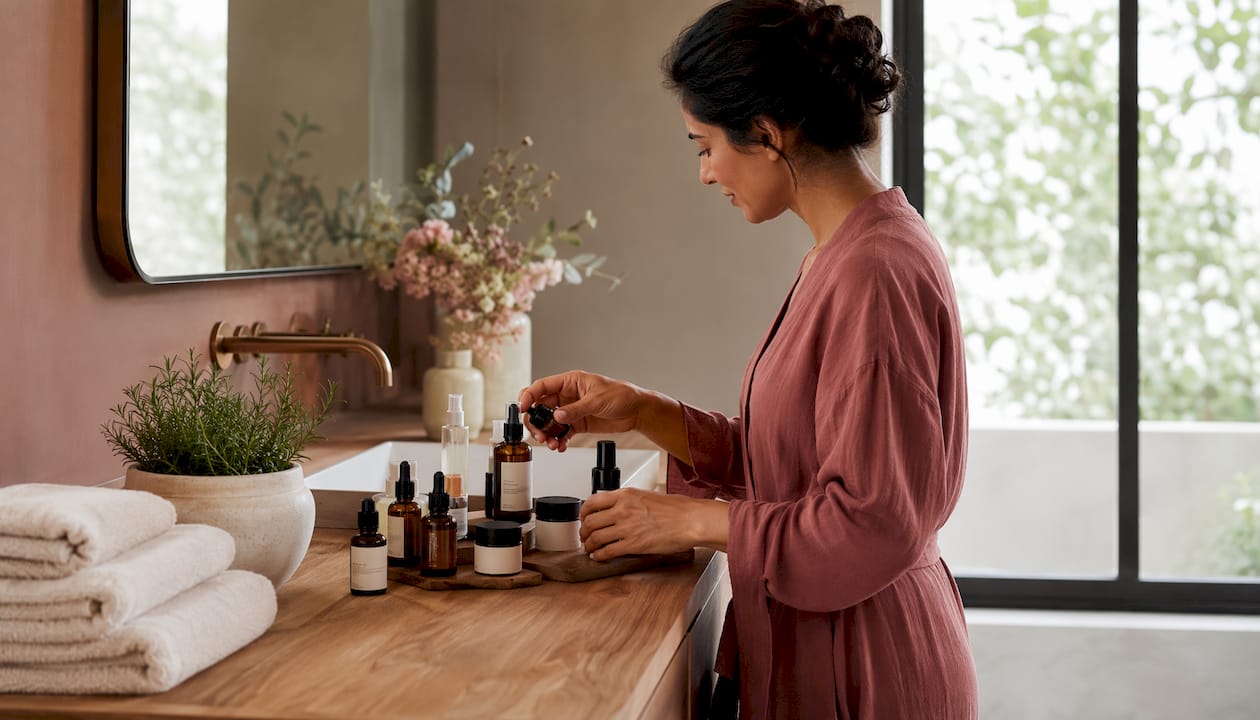
What does a minimal effective skincare routine actually mean?
A minimal effective skincare routine is not about owning fewer products for the sake of it. It means using only the products your skin genuinely needs, chosen for clinically supported ingredients that address your specific concerns, whether that is pigmentation, aging, redness, or uneven texture.
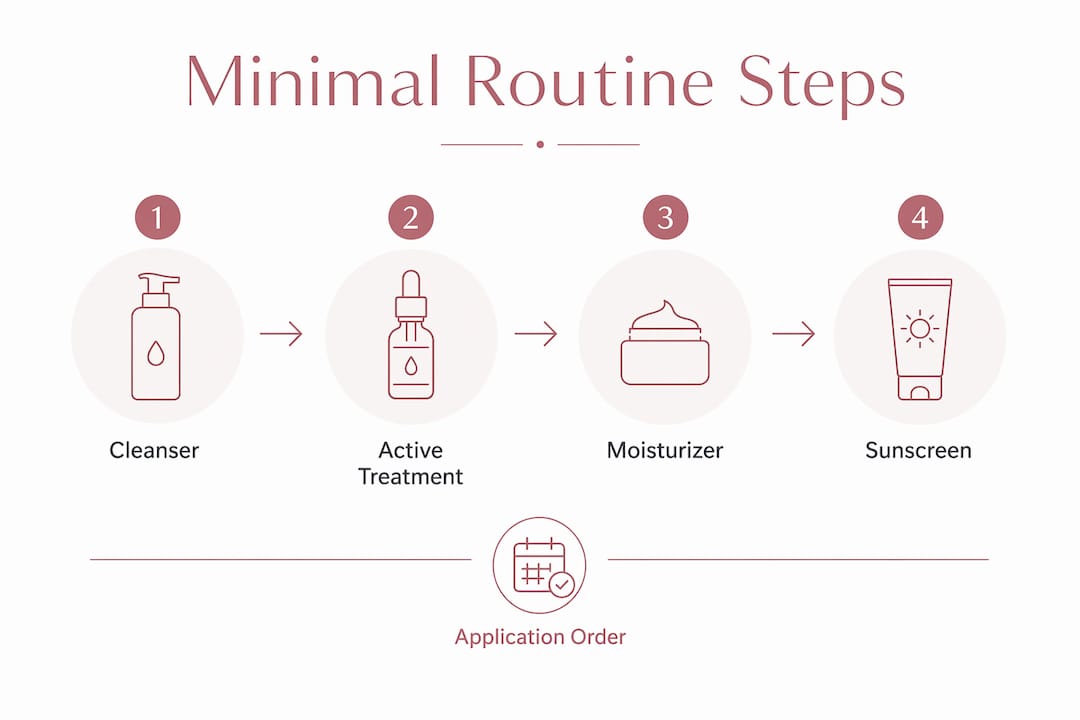
The core of any effective skincare routine comes down to four steps: a gentle cleanser, one targeted active, a barrier-supporting moisturizer, and daily broad-spectrum sunscreen. Everything else is optional. According to dermatologists, minimalism in skincare targets purposeful ingredient selection rather than simply reducing product count.
Before you choose a single product, identify your primary skin concern. Not three concerns. One. Building around that single focus keeps your routine tight and your results measurable.
A minimal routine built for your skin concerns typically includes:
A gentle, low-pH cleanser that removes impurities without stripping your barrier
One active treatment matched to your primary concern (retinoid for aging and texture, vitamin C for pigmentation and dullness, niacinamide for redness)
A moisturizer with ceramides or hyaluronic acid to support barrier health
Broad-spectrum SPF 30+ sunscreen every morning, without exception
Gradual introduction of any new product, one at a time, to monitor your skin’s response
Table of Contents
## 1. Choose a cleanser that respects your skin barrier
Your cleanser sets the tone for everything that follows. A formula that leaves your skin feeling tight or squeaky has already stripped the acid mantle, making every product you apply afterward work harder than it should. Look for a gentle, non-foaming option with a pH around 5.5, free from harsh sulfates and added fragrance.

Wash once in the morning and once at night. If you did not sweat heavily or wear makeup, a gentle rinse with water in the morning is often enough. Over-cleansing triggers rebound oiliness and irritation that can be mistaken for a skin type problem rather than a routine problem.
2. Select one active treatment for your primary concern
This is where a minimal routine gets specific. Rather than stacking multiple serums, pick a single active ingredient that targets your biggest concern and use it consistently. Retinoids address fine lines and texture. Vitamin C (L-ascorbic acid) targets dullness and pigmentation. Tranexamic acid or alpha arbutin work well for hyperpigmentation. Salicylic acid suits congestion and redness-prone skin.
The key rule: one active per routine. You can alternate two actives across AM and PM, but layering them simultaneously causes irritation and can deactivate each other’s benefits. Vitamin C works best in the morning under sunscreen; retinoids belong in your evening routine only, since UV exposure deactivates them.
3. Apply products from thinnest to thickest
Product application order directly affects how well active ingredients absorb. A thick cream applied before a serum creates a physical barrier that blocks penetration. Always sequence from lightest to heaviest consistency: cleanser, active serum, moisturizer, then sunscreen as your final morning step.
Wait roughly 60 seconds between steps. This gives each layer time to settle before the next one goes on, which prevents pilling and improves absorption. Water-based products always go on before oil-based ones.
4. Match your moisturizer to your environment
Your moisturizer choice should respond to your climate, not just your skin type. A lightweight gel with humectants like glycerin suits humid summers, while a richer cream with ceramides and occlusives like squalane supports your lipid barrier through dry winter months. The same person often needs two different moisturizers across the year.
For women managing redness or a compromised barrier, look for formulas containing ceramides, niacinamide, and panthenol. These ingredients address multiple concerns in one step, which is exactly the kind of efficiency a minimal routine depends on.
5. Never skip broad-spectrum sunscreen
Daily SPF 30+ is the single most effective anti-aging and pigmentation prevention strategy available without a prescription. UV exposure accelerates wrinkles, deepens dark spots, and worsens redness. Consistency matters more than the specific formula you choose. Apply sunscreen as your last skincare step every morning, regardless of season or cloud cover.
Reapply every two hours during extended outdoor time. Most people apply far less product than needed, which significantly reduces protection.
6. Identify your skin type before building your routine
Knowing whether your skin runs dry, oily, combination, or sensitive shapes every product decision you make. Dry skin benefits from cream cleansers and richer moisturizers. Oily skin responds better to gel formulas and oil-free SPF. Sensitive or reactive skin needs fragrance-free products across every step.
Pay attention to how your skin behaves across different seasons and hormonal shifts. Skin changes, and your routine should respond accordingly. A consistent skincare schedule built around your actual skin behavior will always outperform one built around a generic skin type label.
7. Structure your AM and PM routines differently
Morning routines focus on protection. Evening routines focus on repair. Your AM routine: cleanser (or water rinse), vitamin C serum if using one, moisturizer, sunscreen. Your PM routine: cleanser, retinoid or treatment active, moisturizer. That is it.
Retinoids belong exclusively in your evening routine. Applying them in the morning accelerates their breakdown and increases UV sensitivity. Keeping your PM routine to three steps makes it easy to maintain every night without skipping.
8. Patch test every new product before full application
Patch testing before applying anything new to your full face prevents widespread reactions. Apply a small amount to your inner forearm or behind your ear, then wait 24–48 hours. If no redness, itching, or bumps appear, test on a small area near your jawline before committing to full use.
Wait at least one week before introducing another new product. This spacing makes it straightforward to identify the cause if irritation develops.
9. Introduce active ingredients gradually
Slow titration of actives is one of the most important techniques for keeping a minimal routine effective without triggering a barrier crisis. Start retinoids at a low concentration, two or three nights per week, and build up over 12 weeks. If irritation appears, pause the active entirely and return to cleanser, moisturizer, and SPF only for 8–12 weeks while your barrier recovers.
Introduce only one new active at a time, waiting three to four weeks before adding another. This timeline lets you see clearly what is working and what is not.
10. Cut redundant products without hesitation
Eye creams are frequently redundant. A quality moisturizer applied gently around the eye area delivers the same barrier support at a fraction of the cost. Toners are unnecessary for most people when a well-formulated cleanser is already in use. Face mists and sheet masks add negligible benefit to a routine built on clinically active ingredients.
Pro Tip: Read ingredient lists rather than marketing claims. Many “basic” moisturizers already contain niacinamide, ceramides, or peptides at effective concentrations. You may already own a multi-tasking product without realizing it.
11. Choose multi-use products to reduce steps
Multi-functional formulas are the practical backbone of minimalist skincare. A moisturizer that combines ceramides, niacinamide, and hyaluronic acid addresses barrier repair, oil control, and hydration in one step. An SPF formula with antioxidants covers sun protection and free radical defense simultaneously. Fewer products mean fewer opportunities for ingredient conflicts and a routine you will actually maintain.
What Chevonne at Fundamentalskin recommends for personalized minimal routines
Chevonne, Dermal Clinician at Fundamentalskin with 15 years of clinical experience, approaches every client’s routine from a personalized assessment first. Generic routines rarely account for the interplay between pigmentation, barrier sensitivity, and active ingredient tolerance that most women managing multiple skin concerns face.
Fundamentalskin uses organic, Australia-sourced ingredients chosen for gentle efficacy and barrier compatibility. The Larimedical Biomimetic Peel is a cornerstone treatment that complements a minimal home routine by addressing pigmentation, aging, and texture concerns at a clinical level, without downtime. Balancing actives with barrier repair is central to Chevonne’s method, and it is what separates a personalized clinical approach from a generic product recommendation.
How clinical treatments enhance a minimal home routine
A well-built minimal home routine maintains your skin between appointments. Clinical treatments like the Larimedical Biomimetic Peel address concerns at a depth that topical products alone cannot reach. Before-and-after results from Fundamentalskin clients show measurable improvements in skin tone, texture, and pigmentation confirmed through visual documentation.
Skin Parameter | Before Treatment | After Larimedical Biomimetic Peel |
Pigmentation | Visible dark spots and uneven tone | Noticeably reduced discoloration, more even complexion |
Skin texture | Rough, dull surface | Smoother, more refined texture |
Redness | Persistent flushing and sensitivity | Calmer, more balanced skin tone |
Fine lines | Visible surface lines | Reduced appearance with improved skin firmness |
Post-treatment, Chevonne recommends returning to the core three steps: gentle cleanser, barrier moisturizer, and SPF. Reintroduce actives gradually after the skin has fully recovered, typically after two to four weeks depending on individual response.
Key Takeaways
A minimal effective skincare routine built around your primary skin concern, applied in the correct order, consistently, delivers better results than a complex multi-product regimen.
Point | Details |
Four core steps | Cleanser, one active treatment, moisturizer, and SPF 30+ cover every skin type’s essential needs. |
One active at a time | Layering multiple actives causes irritation and reduces efficacy; pick one and use it consistently. |
Patch test first | Apply new products to your inner forearm and wait 24–48 hours before using them on your face. |
Environment shapes moisturizer choice | Use a lightweight gel in humid conditions and a ceramide-rich cream in dry or cold climates. |
Fundamentalskin’s clinical approach | The Larimedical Biomimetic Peel complements a minimal home routine with targeted, no-downtime results for pigmentation, aging, and texture. |
Personalized clinical skincare at Fundamentalskin
Most women managing pigmentation, aging, or redness have tried the product-heavy approach. More serums, more steps, more spending, and still the same concerns in the mirror. Fundamentalskin offers something genuinely different: a personalized clinical plan built around your skin, not a shelf of products.

Led by Chevonne, a Dermal Clinician with 15 years of experience, Fundamentalskin pairs a minimal, organic-ingredient home routine with targeted in-clinic treatments like the Larimedical Biomimetic Peel. The results are visible, documented, and achieved without downtime. You get a routine that is simple enough to maintain every day and clinical support that actually moves the needle on your skin concerns. Book your personalized skin consultation with Fundamentalskin and start seeing the difference that focused, expert care makes.
Recommended
Comments