.png)
How Organic Ingredients Absorb Into Skin: The Truth


Skin absorption of organic ingredients is determined by molecular size, solubility, and formulation design, not by whether an ingredient is certified organic. Understanding how organic ingredients absorb into skin means knowing the 500 Dalton Rule, the skin’s lipid barrier, and how delivery systems like liposomes change what actually reaches living tissue. The stratum corneum, your outermost skin layer, is a selective barrier built to keep most substances out. That biological fact applies equally to synthetic and organic compounds. What gets through depends on physics and chemistry, not origin.
How do organic ingredients absorb into skin?
Skin absorption is a multi-step process: a product spreads across the surface, the active ingredient releases from its formula, interacts with the skin barrier, and then passes into deeper layers. Not every ingredient completes all four steps. Some organic compounds deliver real benefits by staying on the surface, providing hydration or protection without ever penetrating. Others need to reach the dermis to work. Knowing which category your ingredient falls into tells you a lot about what a product can realistically deliver.
The stratum corneum is made up of dead, flattened cells surrounded by a lipid matrix of ceramides, fatty acids, and cholesterol. This structure is designed to block water loss and repel foreign substances. Two main pathways exist for ingredient entry: the transcellular route (through cells) and the intercellular route (between cells through the lipid matrix). A third minor pathway runs through hair follicles and sweat glands. Most organic actives travel the intercellular route, which means their compatibility with skin lipids is critical.
Formulation also shapes what your skin actually receives. The vehicle in product design increases contact time, controls release rate, and distributes actives across the skin surface. A beautifully sourced organic botanical in a poorly designed base may sit on the surface and evaporate before it can do anything useful.
What is the 500 dalton rule and why does it matter?
The 500 Dalton Rule is the standard molecular weight cutoff for passive dermal penetration. Ingredients above 500 Daltons cannot penetrate healthy, intact skin without barrier disruption. That single fact reshapes how you should read most skincare marketing.
To put it in context, retinol sits at approximately 286 Daltons and penetrates well. Vitamin C (ascorbic acid) is around 176 Daltons. Hyaluronic acid, one of the most heavily marketed skincare ingredients, ranges from 100,000 to 1,000,000 Daltons in its standard form. It cannot penetrate the skin barrier unaided. The same rule applies to many organic actives:
Collagen peptides in their full form are far too large to pass through intact skin
Stem cell extracts and growth factors marketed as organic actives are typically large, hydrophilic molecules that cannot bypass the skin barrier without disruption
Resveratrol sits at 228 Daltons and does penetrate, making it a genuinely effective organic antioxidant
Quercetin, a plant flavonoid, is around 302 Daltons and can cross the barrier under the right formulation conditions
Caffeine at 194 Daltons penetrates effectively, which is why it works in eye creams
The biological purpose of this size restriction is protective. Your skin is not supposed to be permeable. It evolved to keep pathogens, toxins, and environmental irritants out. The 500 Dalton Rule is not a flaw in skincare science. It is the skin doing its job.
Pro Tip: When evaluating a product’s active ingredient claims, search the ingredient name alongside its molecular weight. If it exceeds 500 Daltons and the product uses no advanced delivery system, the ingredient is working at the surface level only.
Oil-soluble vs. water-soluble: which organic ingredients penetrate better?
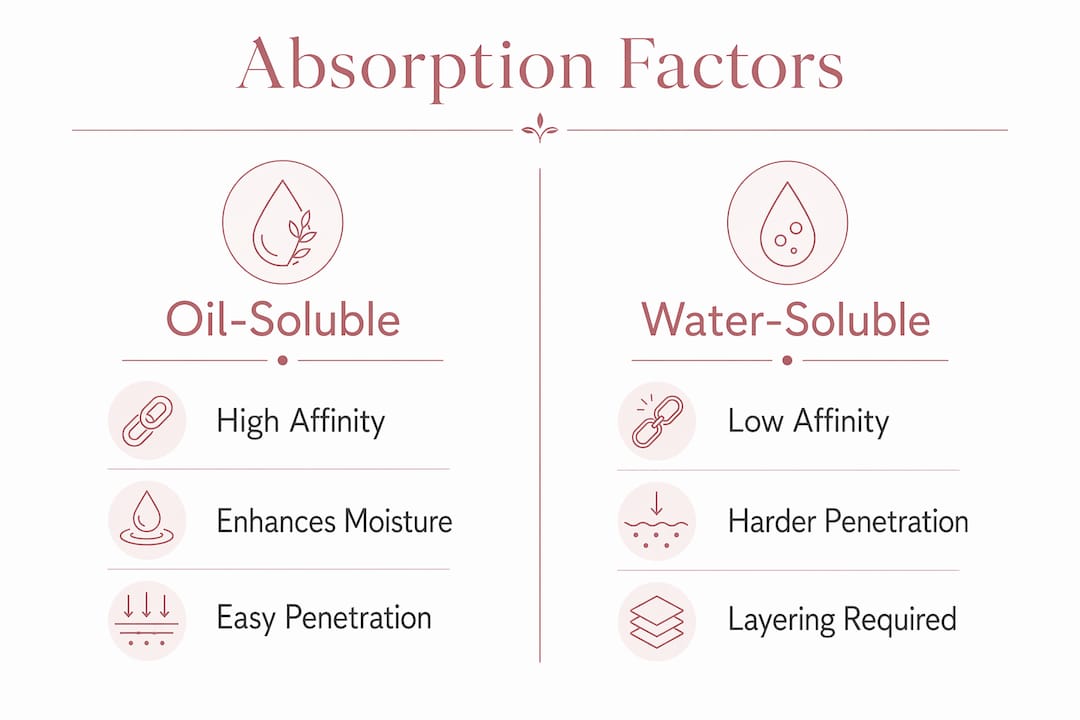
The skin’s lipid-rich stratum corneum has a natural affinity for oil-soluble (lipophilic) molecules. Lipophilic ingredients pass through the intercellular lipid matrix more efficiently than water-soluble ones, which require specialized delivery vehicles to reach deeper layers.
Property | Oil-Soluble (Lipophilic) | Water-Soluble (Hydrophilic) |
Skin affinity | High: compatible with lipid matrix | Low: repelled by lipid barrier |
Penetration route | Intercellular lipid pathway | Requires delivery vehicle or disruption |
Examples | Vitamin E, retinol, CBD oil | Vitamin C, niacinamide, hyaluronic acid |
Absorption speed | Faster passive penetration | Slower without formulation support |
Surface benefit | Moderate | High (hydration, barrier repair) |
Organic plant oils like jojoba and sunflower oil improve moisture retention and reinforce the lipid matrix of the stratum corneum. Jojoba oil is structurally similar to human sebum, which is why it absorbs without leaving a heavy residue. Sunflower oil is rich in linoleic acid, a fatty acid that supports the skin’s protective barrier. These oils do not penetrate deeply into the dermis, but their surface and upper-barrier benefits are real and clinically supported.
Water-soluble organic ingredients like green tea extract or aloe vera polysaccharides face a harder path. Their hydrophilic nature means the lipid barrier repels them. Without a delivery system, they remain on the skin surface. That is not always a problem. Aloe vera’s soothing and hydrating effects happen largely at the surface level, and they are still valuable. The issue arises when brands claim deep cellular repair from water-soluble actives in a basic lotion base.
Pro Tip: Apply oil-soluble serums before moisturizer and water-soluble actives like vitamin C on clean, slightly damp skin. Damp skin temporarily increases permeability, giving water-soluble ingredients a slightly better chance of penetrating.
What role do delivery systems play in deeper absorption?
Advanced delivery systems are the most significant development in organic skincare effectiveness over the past decade. Nanocarrier systems like liposomes and ethosomes improve skin penetration by modulating lipid layers and facilitating controlled delivery to targeted skin depths.
Here is how the main delivery technologies work in practice:
Liposomes are spherical lipid vesicles that mimic the skin’s own membrane structure. They fuse with the stratum corneum lipids and release their payload inside the barrier rather than on top of it. Vitamin C encapsulated in liposomes reaches deeper skin layers than standard ascorbic acid serums.
Ethosomes are modified liposomes containing ethanol. The ethanol component increases membrane fluidity, allowing the vesicle to squeeze through tighter lipid spaces. They are particularly effective for delivering larger organic molecules that would otherwise be blocked.
Solid lipid nanoparticles (SLNs) provide a solid lipid core that protects unstable organic actives like resveratrol and curcumin from oxidation during storage and releases them gradually once applied.
Nanoemulsions reduce droplet size to below 200 nanometers, dramatically increasing surface area contact with the skin and improving both spreadability and penetration depth.
The research is clear: hydrophobic phytochemicals in nanocarriers achieve improved solubility, stability, and targeted release. Curcumin, a powerful anti-inflammatory from turmeric, is nearly insoluble in water and degrades quickly. Encapsulated in lipid nanoparticles, it becomes both stable and deliverable to skin layers where inflammation actually occurs.
Delivery System | Best For | Key Advantage |
Liposomes | Vitamin C, peptides | Mimics skin membrane for easy fusion |
Ethosomes | Larger organic molecules | Ethanol increases lipid fluidity |
Solid lipid nanoparticles | Unstable actives (curcumin, resveratrol) | Protects from oxidation, controlled release |
Nanoemulsions | Broad-spectrum actives | Maximizes surface contact and spreadability |
The real role of organic ingredients in skincare is often misunderstood precisely because delivery technology is invisible to the consumer. A product with a sophisticated nanocarrier system will outperform a product with a higher concentration of the same organic active in a basic emulsion every time.
How to choose organic skincare products that actually work
Choosing products that deliver on their absorption claims requires looking past marketing language and into formulation details. Here is what to evaluate:
Check molecular weight compatibility. If a product claims deep cellular repair from an ingredient above 500 Daltons with no mention of a delivery system, the claim is surface-level at best. Look for terms like “nano,” “liposomal,” or “encapsulated” on the label.
Assess solubility and layering order. Apply water-based products first on clean skin, then layer oil-based products on top. This follows the skin’s natural chemistry and prevents oil from blocking water-soluble actives.
Prioritize pH alignment. Vitamin C (ascorbic acid) requires a pH below 3.5 to penetrate effectively. If your vitamin C serum has a pH of 6, it is not absorbing. Many organic vitamin C products use pH-stable derivatives like ascorbyl glucoside, which work at higher pH but penetrate differently.
Consider your skin barrier health. A compromised barrier from over-exfoliation, harsh cleansers, or chronic dryness absorbs more, but not in a good way. Irritants and allergens also get through more easily. Healthy barrier function is the foundation for controlled, beneficial absorption.
Read the full ingredient list. The organic skincare routine you build should include products where the active ingredient appears in the top third of the list. Ingredients listed last are present in trace amounts and unlikely to produce meaningful results.
Look for clinical evidence, not just certifications. An organic certification confirms sourcing standards. It does not confirm absorption efficacy. Before-and-after data, clinical trials, and dermatologist-tested claims are stronger indicators of real results.
Understanding what organic skincare really means helps you separate genuine quality from label claims. Organic sourcing matters for purity and reduced chemical load, but it does not automatically mean better penetration.
Key takeaways
Organic ingredient absorption depends on molecular size, lipid solubility, and formulation design, not on organic certification alone.
Point | Details |
The 500 Dalton Rule | Ingredients above 500 Daltons cannot penetrate intact skin without advanced delivery or barrier disruption. |
Lipid solubility matters | Oil-soluble organic actives penetrate the stratum corneum more efficiently than water-soluble ones. |
Formulation drives results | The delivery vehicle determines how well an active ingredient spreads, releases, and migrates through skin layers. |
Nanocarriers change the game | Liposomes, ethosomes, and solid lipid nanoparticles enable larger or unstable organic actives to reach deeper skin layers. |
Surface benefits are real | Not all absorption is deep; organic oils like jojoba and sunflower oil deliver genuine barrier and hydration benefits at the surface level. |
What 15 years in a treatment room taught me about organic absorption
Most of my clients arrive believing that organic automatically means more effective. I understand why. The marketing is convincing, and the intention behind choosing organic is genuinely good. But after 15 years working with real skin, I can tell you that the most common skincare disappointment I see comes from this exact misunderstanding.
I have seen clients spending significant money on organic serums packed with botanicals that simply cannot penetrate intact skin in their current form. The ingredients are beautiful. The sourcing is ethical. The formulation is basic. The result is a very expensive moisturizer.
What actually moves the needle is the combination of the right molecular size, the right solubility, and a delivery system designed to get the active where it needs to go. That is why I am so particular about the products and treatments we use at Fundamentalskin. Organic sourcing is a starting point, not an endpoint. The science of delivery is what separates a product that feels nice from one that changes your skin.
My honest advice: stop reading the front of the label and start reading the back. Look for liposomal or encapsulated actives. Check whether the active ingredient is listed high enough to matter. And if a product promises deep cellular transformation from a basic cream with no delivery technology, be skeptical. Your skin deserves both clean ingredients and smart science.
— chevonne
Experience organic ingredients the way your skin can actually use them
Understanding the science behind absorption is one thing. Experiencing it in a treatment designed around it is another.

At Fundamentalskin, the Biomimetic Peel + LED Therapy is built on exactly these principles. The peel phase prepares the skin barrier, temporarily increasing permeability so that organic actives can reach the layers where they create real change. The LED therapy phase then supports cellular response and collagen activity. Together, they work with your skin’s biology rather than against it. If you are ready to see what organic ingredients can do when formulation and delivery are done right, this is where to start. BOOK NOW and experience the difference that clinical expertise makes.
For clients interested in specialized peeling treatments, the Larimedical peel options at Fundamentalskin offer another pathway to healthier, more receptive skin.
FAQ
What is the 500 dalton rule in skincare?
The 500 Dalton Rule defines the maximum molecular weight for passive skin penetration. Ingredients above this threshold cannot cross intact skin without barrier disruption or advanced delivery technology.
Do organic ingredients absorb better than synthetic ones?
No. The skin’s barrier responds to molecular size and solubility, not ingredient origin. An organic compound above 500 Daltons absorbs no better than a synthetic one of the same size.
What organic oils actually penetrate the skin?
Jojoba oil and sunflower oil reinforce the stratum corneum’s lipid matrix and improve moisture retention. They work primarily at the barrier level rather than penetrating deeply into the dermis.
How do liposomes help organic ingredients absorb deeper?
Liposomes are lipid vesicles that fuse with the skin’s membrane structure and release their active payload inside the barrier. This allows water-soluble or larger organic actives to reach skin layers they could not access in a standard formula.
Does skin condition affect how well organic ingredients absorb?
Yes. A compromised skin barrier absorbs more substances, including irritants. Healthy, intact skin controls absorption selectively. Supporting barrier health with ceramides and fatty acids creates the best foundation for effective ingredient delivery.
Recommended
Comments